
CBD (cannabidiol) is a non-intoxicating compound found in Cannabis sativa. It doesn't get you high — that's THC. But CBD does interact with your body in measurable ways through the endocannabinoid system. Here's what the science actually says, what's still uncertain, and why delivery method and extract type matter more than most people realize.
What Is CBD?
- Cannabidiol (CBD)
- CBD is defined as a phytocannabinoid — a plant-derived compound that interacts with the human endocannabinoid system. It was first isolated by Roger Adams in 1940 and structurally characterized by Raphael Mechoulam in 1963 (Mechoulam & Shvo, Tetrahedron, 1963). CBD is the second most abundant cannabinoid in hemp after its acidic precursor CBDA.
- Endocannabinoid System (ECS)
- The ECS is a biological signaling network present in all mammals. It consists of endocannabinoids (compounds your body produces naturally), CB1 receptors (concentrated in the brain and central nervous system), and CB2 receptors (primarily in immune cells and peripheral tissue). The ECS helps regulate sleep, mood, appetite, pain perception, and immune response.
- Full-Spectrum Extract
- Full-spectrum CBD contains cannabidiol plus other naturally occurring cannabinoids (CBG, CBN, CBC), terpenes, and flavonoids — including trace THC under 0.3%. This is distinct from broad-spectrum (THC removed) and isolate (pure CBD only, 99%+).
How CBD Interacts with the Body
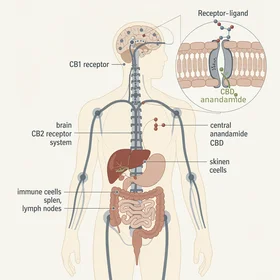
Unlike THC, CBD does not strongly bind to CB1 or CB2 receptors. Instead, it modulates the endocannabinoid system indirectly through several mechanisms:
- FAAH inhibition. CBD inhibits fatty acid amide hydrolase (FAAH), the enzyme that breaks down anandamide — an endocannabinoid associated with mood regulation and pain modulation. By slowing anandamide breakdown, CBD may increase its availability in the body.
- Serotonin receptor activation. CBD interacts with 5-HT1A serotonin receptors, which are involved in mood and stress response. This mechanism is behind most of the anxiolytic research on CBD (Blessing et al., Neurotherapeutics, 2015).
- TRPV1 receptor modulation. CBD activates vanilloid receptors (TRPV1), which play a role in pain perception and inflammation signaling.
- Allosteric modulation of CB1. CBD acts as a negative allosteric modulator of CB1 receptors, meaning it changes the shape of the receptor so THC binds less effectively. This is why CBD can reduce some of THC's psychoactive effects.

The Entourage Effect
The entourage effect is the theory that cannabis compounds work better together than in isolation. A 2011 review by Ethan Russo (British Journal of Pharmacology) provided the most cited framework: terpenes like myrcene, linalool, and limonene may enhance CBD's effects through complementary receptor activity.
This is why full-spectrum extracts are generally preferred over CBD isolate in clinical settings. Populum uses full-spectrum extraction specifically to preserve these companion compounds. However, the entourage effect remains a theory — not all researchers agree on its magnitude, and isolate-based products can still be effective for some people.
Bioavailability by Delivery Method
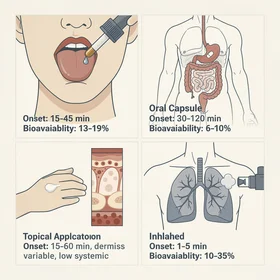
How you take CBD matters as much as how much you take. Bioavailability — the percentage of CBD that reaches your bloodstream — varies dramatically by delivery method:
Populum's tinctures are designed for sublingual use — hold the oil under your tongue for 60-90 seconds for best absorption. Their capsules go through oral digestion, which has lower bioavailability but offers consistent dosing. See our product overview for details on each format.
What Research Shows (and Doesn't)
CBD research is growing but still limited by small sample sizes, short study durations, and the lack of standardized dosing protocols. Here's a honest summary:
- Anxiety: Several small clinical trials suggest CBD may reduce situational anxiety. A 2019 study of 72 adults found CBD reduced anxiety scores in 79.2% of participants within the first month (Shannon et al., The Permanente Journal, 2019). But these trials are small and not yet replicated at scale.
- Sleep: The same Shannon study found 66.7% of participants reported improved sleep in the first month — but scores fluctuated over time, suggesting the effect may not be sustained.
- Pain: Most pain research involves THC+CBD combinations (like Sativex), not CBD alone. The evidence for CBD-only pain relief in humans is preliminary.
- Epilepsy: The strongest evidence. Epidiolex (pure CBD, prescription) is FDA-approved for Dravet syndrome and Lennox-Gastaut syndrome — rare, severe forms of childhood epilepsy.
Cons & Considerations
- Drug interactions. CBD inhibits CYP3A4 and CYP2C19 liver enzymes, which metabolize many common medications including blood thinners, statins, and SSRIs. Always consult a healthcare provider if you take prescription drugs.
- Not FDA-regulated as a supplement. Despite widespread sales, CBD has no FDA regulatory framework for dietary supplements. Quality varies enormously across brands — which is why third-party lab testing (like Populum's batch-specific COAs) is the primary quality indicator. Starting April 2026, some Medicare ACOs can offer oral hemp CBD. See CBD and Medicare.
- Dose-response is individual. There is no universal CBD dose. What works for one person may have no effect on another. Start low (10-25mg/day), give it 5-7 days, and adjust gradually.
- THC accumulation. Full-spectrum products contain trace THC (under 0.3%). With daily use, THC can accumulate and potentially trigger a positive drug test.
- Oversold benefits. The CBD industry is rife with exaggerated health claims. CBD is not a cure for anything. It may support wellness for some people, but it's not a replacement for medical treatment.
Have more questions? Our FAQ covers dosing, drug testing, and how to get started with Populum. Learn more about the company and their lab transparency commitment.